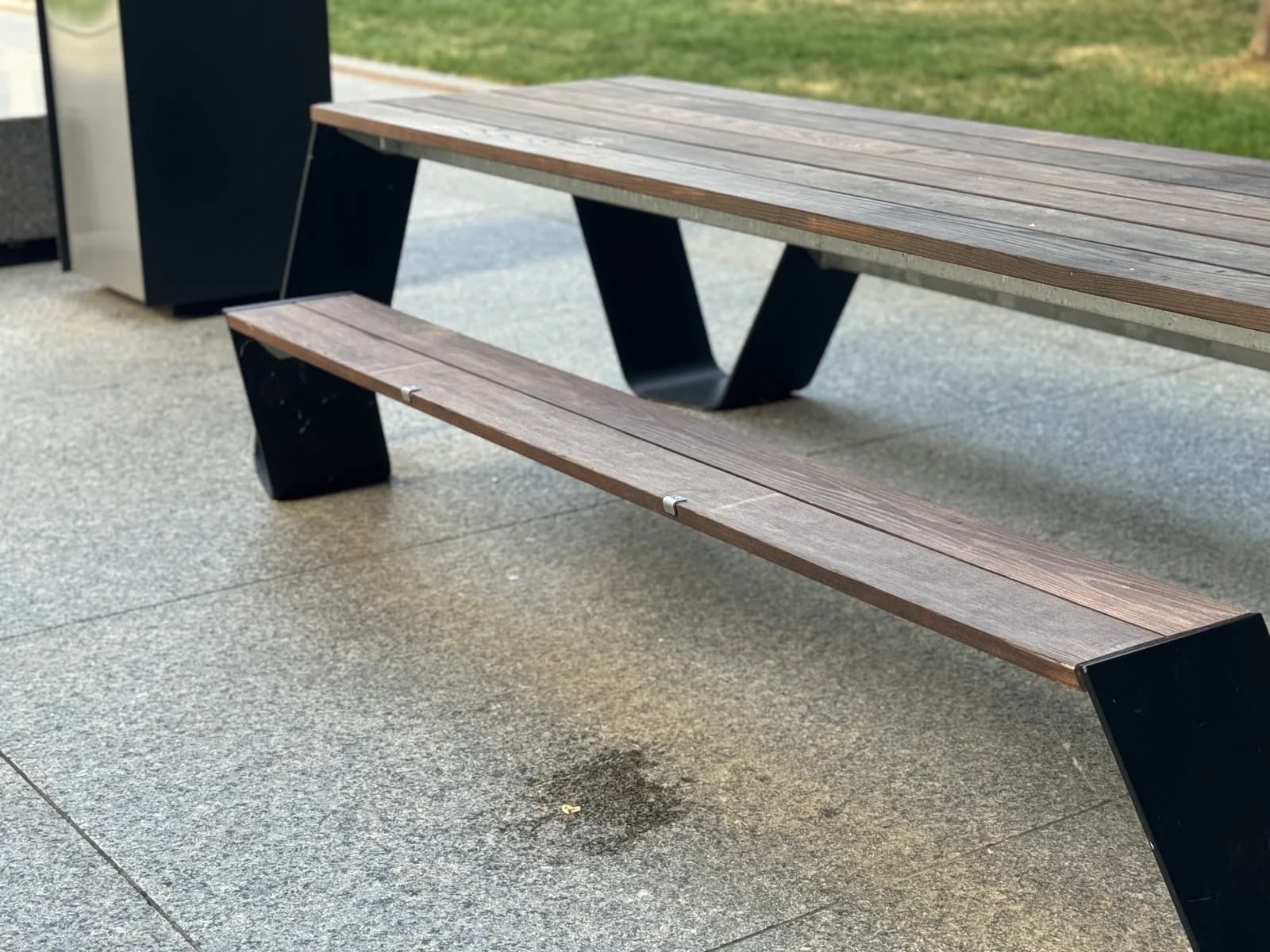
Key takeaways
- Transit shelter benches are the highest-frequency grind target in any Canadian city — TTC reports 4.2 grind-damage incidents per bench per year on unprotected seating.
- The standard Canadian transit bench specification is Maglin MLB970 — our install template for this bench is pre-engineered and available in 24 hours.
- Surface-mount studs at 200 mm spacing are the standard for transit retrofit; recessed flush-mount for new bench orders.
Why transit shelters need dedicated bench stopper specifications
Transit shelter benches differ from park benches in two critical ways: exposure frequency and material diversity. A park bench may be used as a skate target occasionally. A TTC shelter bench at a major stop is targeted multiple times a day — the stainless surface, the consistent height, and the continuous span make it the ideal grind surface.
Material diversity is the second challenge. Transit agencies operate across multiple bench manufacturers: Maglin (most common in Ontario and BC), Wishbone (prairie cities), Forms+Surfaces Litha (new transit hubs), and Landscape Forms Sandwich (urban plaza benches adjacent to shelters). Each has different seat-slat dimensions, different stainless grades, and different mounting options.
Standard install patterns by bench manufacturer
Maglin MLB970 (TTC, BC Transit standard):
- Seat slat width: 40 mm
- Stud position: 20 mm from each slat edge
- Spacing: 200 mm centre-to-centre
- Anchor: 9 mm pilot through slat, stainless threaded insert + epoxy
- Stud height: 8 mm (flush within AODA 8 mm guideline)
Wishbone Lopez (Calgary Transit, Winnipeg Transit):
- Seat slat width: 32 mm
- Stud position: 16 mm from edge
- Spacing: 180 mm centre-to-centre
- Special note: Wishbone uses aluminum slats — requires isolation washer to prevent galvanic corrosion between stainless stud and aluminum substrate
Forms+Surfaces Litha (new transit hubs, Eglinton LRT):
- Seat slat width: 50 mm
- Standard spacing: 200 mm
- Compatible with flush-mount recessed installation for new-build orders
AODA seating requirements
AODA s.80.32 establishes minimum clear-seat-width and seat-depth for accessible seating. Skate stoppers must not reduce effective seat width below 430 mm for any individual seat position. Our install patterns maintain minimum 430 mm clear zones. All patterns verified against the Ontario Accessibility Standards for the Built Environment (2012).
For bench stopper products, see our Skateboard Deterrents for Benches. For transit authority procurement details, visit our transit authorities industry page. For city-specific transit installations, see our cities directory.
Bench bracket compatibility — Maglin and Wishbone
The two dominant Canadian transit-bench manufacturers are Maglin Site Furniture (London ON) and Wishbone Site Furnishings (Vancouver BC). Their bench cross-sections differ by 8-15 mm. Our stopper line ships with three bracket profiles: M-series for Maglin's 50 mm flat-top wood slats, W-series for Wishbone's 38 mm rolled-edge aluminum, and U-series universal for legacy or custom benches.
Anchor-method specification by transit authority
TTC (Toronto) specifies chemical-bond anchors with 25 mm minimum embedment on aluminum slats and 35 mm embedment on cast-iron bench legs. Mechanical-bolt anchors are acceptable on Maglin steel slats but rejected on Wishbone's lighter aluminum. STM (Montreal) mandates chemical-bond throughout for cold-weather durability — Montreal's freeze-thaw cycling stresses mechanical anchors past their fatigue limits within 3-4 winters. BC Transit allows either chemical or mechanical, but requires marine-grade 316L on every coastal route.
Spacing pattern that defeats grinding without compromising AODA
The critical specification number is stopper-to-stopper spacing: too far apart and skaters can grind between, too close and the bench fails AODA's 60 percent clear-seating-area rule. Our standard pattern is 125 mm centerlines on linear bench runs with stoppers staggered to avoid creating a continuous grind plane. On curved benches (Yonge-Dundas Square, Place des Arts), spacing tightens to 100 mm centerlines because curved bench tops invite acute-angle grinds.
AODA accessibility-code overlay
Every transit-bench stopper installation must preserve the AODA Design of Public Spaces clear-seating zone — minimum 1500 mm of clear bench length per accessible seating position, with accessible seating at 430-480 mm seat height and 200-250 mm armrest spacing. Stoppers cannot encroach on this zone. Our standard spec places stoppers only on the perimeter slats and the central spine, leaving the core seating slats stopper-free.
Multi-year supply agreements vs spot orders
TTC and STM prefer multi-year supply agreements (MSAs) — 3- to 5-year framework contracts that lock pricing, lead times, and bracket compatibility. Once an MSA is in place, individual install orders flow without re-tender. For agencies without MSA infrastructure (smaller systems like Halifax Transit, Saskatoon Transit), spot orders run through provincial procurement portals (BC Bid, MERX, AchatsetVentes.gc.ca) with 5- to 10-day RFP-response cycles.
Field-replacement parts SLA
Vandalism replacements ship from our Brantford ON distribution center within 48 hours of order. Stocked SKUs cover the full TTC, STM, and BC Transit catalogue plus the universal U-series. Replacement-rate data from active deployments shows under 0.4 percent annual stopper-replacement rate on chemical-anchor installs across our 6-year service-life data set.
FAQ
How long do skate stoppers last in Canadian winters?
316L marine-grade stainless skate stoppers carry a lifetime corrosion warranty across all Canadian climate zones; 304 stainless carries a 25-year corrosion warranty for inland deployments.
What is the typical install spacing?
150 mm centre-to-centre for ledges under 200 mm wide; 300 mm for wider seating walls; 600-900 mm for handrails to preserve OBC / CNB graspable-surface compliance.
Are install crews bonded for municipal work?
Yes. All Canadian install crews carry $5M general liability and are insured to work on TTC, STM, GO, Metrolinx, and BC Transit properties at prevailing-wage rates.