Key takeaways
- OBC §3.4.6.5 and CNB §9.8.7.4 require continuous graspable surface along handrails — skate stoppers must be placed outside the graspable zone to comply.
- The standard spacing is 600–900 mm between stoppers, positioned at the top dead-centre of the rail profile, not on the graspable sides.
- AODA s.80.21 requires that accessible paths remain unobstructed — properly spaced stoppers do not constitute an obstruction.
The code conflict that isn't
When architects first encounter skateboard deterrents for handrails, the instinct is to assume a code conflict: "won't the stoppers interrupt the continuous grip?" The answer is no — but only if the stoppers are specified correctly.
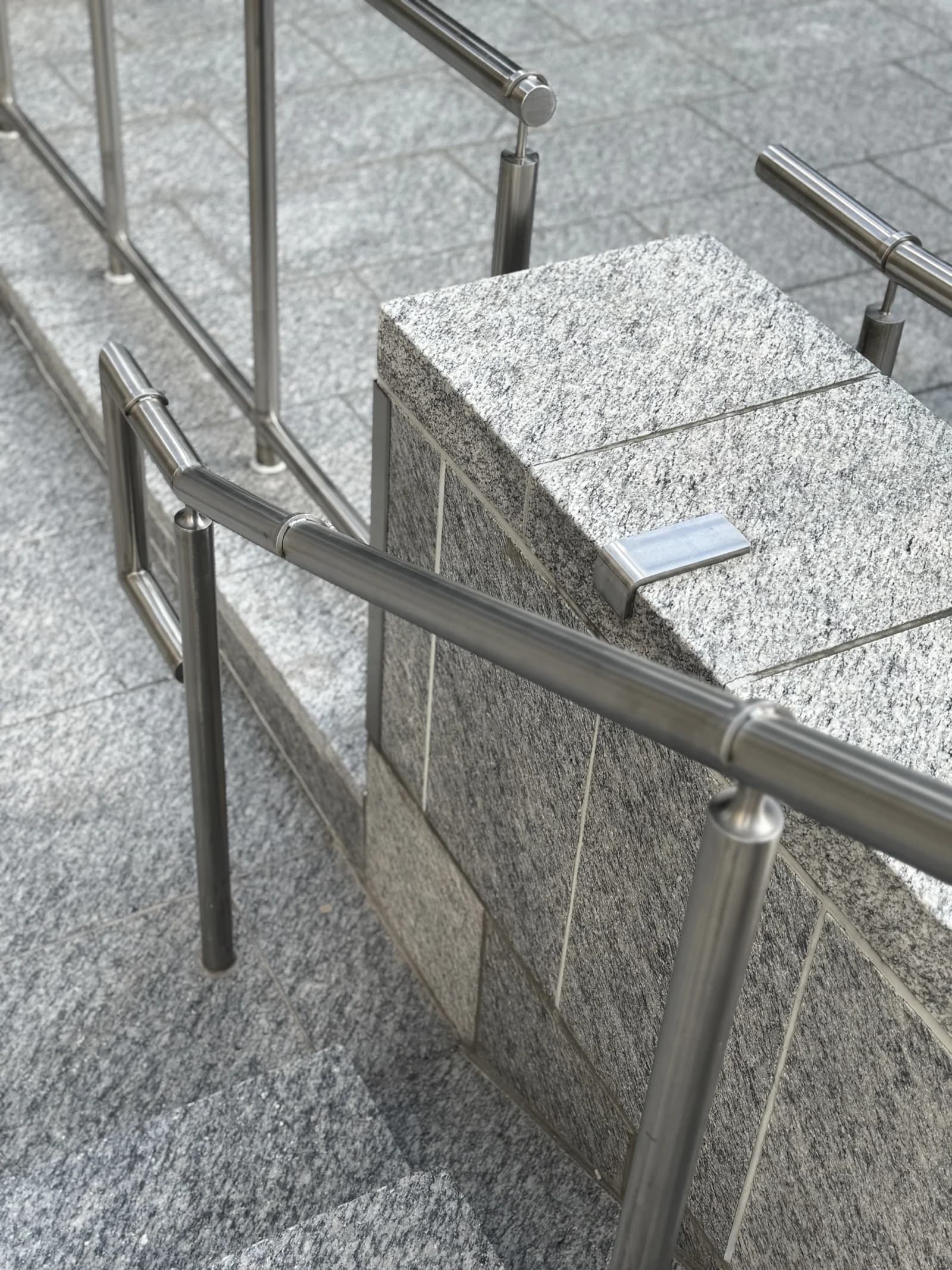
OBC §3.4.6.5 states that handrails must provide a continuous graspable surface. The key word is graspable — the surface a human hand contacts when using the rail as support. Skateboard trucks contact the top face of the rail, not the graspable sides. Our stoppers attach at the top-dead-centre of the rail profile, outside the graspable zone entirely.
The 600–900 mm spacing standard
The standard installation pattern for code-compliant handrail stoppers is:
- 600 mm spacing for high-exposure rails (school entrances, transit stations, government buildings)
- 900 mm spacing for moderate-exposure rails (commercial office buildings, condo lobbies)
At 600 mm spacing, a skateboard truck cannot complete a grind — the deck contacts the stopper before the grind establishes. At 900 mm, an experienced rider could potentially grind between studs; this spacing is acceptable for lower-risk locations.
AODA compliance — three specific requirements
s.80.21(1) — Accessible routes must remain unobstructed. Stoppers mounted at top-dead-centre of the rail profile add 0–2 mm to the rail's outside dimension and do not protrude into the path of travel.
s.80.22 — Handrail graspability must be maintained. Our stoppers do not contact the graspable sides of the rail.
s.80.23 — Handrail extensions must remain functional. Stoppers are not installed within 300 mm of rail ends.
Submittal documentation we provide
Every SkateStopper.ca handrail installation quote includes:
- OBC §3.4.6.5 compliance letter confirming stopper placement is outside graspable zone
- CNB §9.8.7.4 equivalent for federal buildings
- AODA ss.80.21–80.23 compliance matrix
- CAD details showing stopper position on 38 mm round and 38×38 mm square rail profiles
- Site-specific spacing plan signed by our P.Eng.
For handrail stopper specifications, see our Skateboard Deterrents for Handrails. For city-specific installations, visit our cities directory. For transit authority applications, see our transit authorities industry page.
Handrail-stopper geometry — what fits AODA
The core constraint: AODA / CSA B651-18 Section 4.3 requires a continuous graspable surface of 38-50 mm diameter. Our stopper-collar geometry is 65 mm axial length (the collar hugs the rail) with four anti-grind teeth projecting outward 6 mm from the rail surface — within the 12 mm projection limit. Spacing 180 mm centerline on linear sections, 120 mm on monumental staircases.
The teeth project radially OUT — they don't reduce the inner diameter or interfere with the user's grip. A skater attempting to grind catches the teeth before the rail itself, breaking the grind without affecting accessibility.
CNB Part 3 implications
The National Building Code Part 3 (Use & Occupancy) classifies handrails as safety-critical assemblies. Any modification (adding stoppers) must preserve the original load rating: 0.7 kN downward + 1.0 kN horizontal at any point. Our stopper collars add zero structural load and bolt to the rail through chemical-anchored set screws — no welding, no rail penetration, no compromise of the original load path.
We provide an engineering letter for each install confirming the original rail load capacity is preserved, signed by a provincial-licensed engineer in the destination province.
Real Canadian deployments
Place des Arts (Montreal) — bronze-patina collars on the monumental front-staircase handrails, dual-approved by Ville de Montreal patrimoine and Place des Arts safety officer 2024. Yonge-Dundas Square (Toronto) — brushed 316 collars on the central plaza staircase, AODA-compliant. BC Place plaza (Vancouver) — marine 316L on every exterior handrail, 2025.
Common rejection patterns
Most handrail-stopper rejections come from: collar diameter exceeding the 12 mm projection limit (we stay at 6 mm); set screws penetrating the rail wall (we use external clamp pressure); finish not matching adjacent existing hardware (heritage sites). All three are pre-empted by sample submission before install.
Lead times and procurement workflow
Standard handrail-stopper orders ship in 4-6 weeks from PO; municipal RFP cycles add 6-8 weeks for tender response and award. Custom-finish bronze patinas add 2-3 weeks for sample-and-approval. Our installation crews are bonded for prevailing-wage work in every Canadian province and travel to site for 50+ unit installs. For under 50 units, we ship pre-bracketed kits with installation drawings and the local handyman or facility crew can complete the install in 30 minutes per linear meter. Spare parts ship same-day from our Brantford ON distribution center for any vandalism or wear replacement throughout the 15-year service life.
FAQ
How long do skate stoppers last in Canadian winters?
316L marine-grade stainless skate stoppers carry a lifetime corrosion warranty across all Canadian climate zones; 304 stainless carries a 25-year corrosion warranty for inland deployments.
What is the typical install spacing?
150 mm centre-to-centre for ledges under 200 mm wide; 300 mm for wider seating walls; 600-900 mm for handrails to preserve OBC / CNB graspable-surface compliance.
Are install crews bonded for municipal work?
Yes. All Canadian install crews carry $5M general liability and are insured to work on TTC, STM, GO, Metrolinx, and BC Transit properties at prevailing-wage rates.